
At first, I thought my child would write only a few lines. But one handwritten scene led to another, and every new location suggested something else that might happen there.
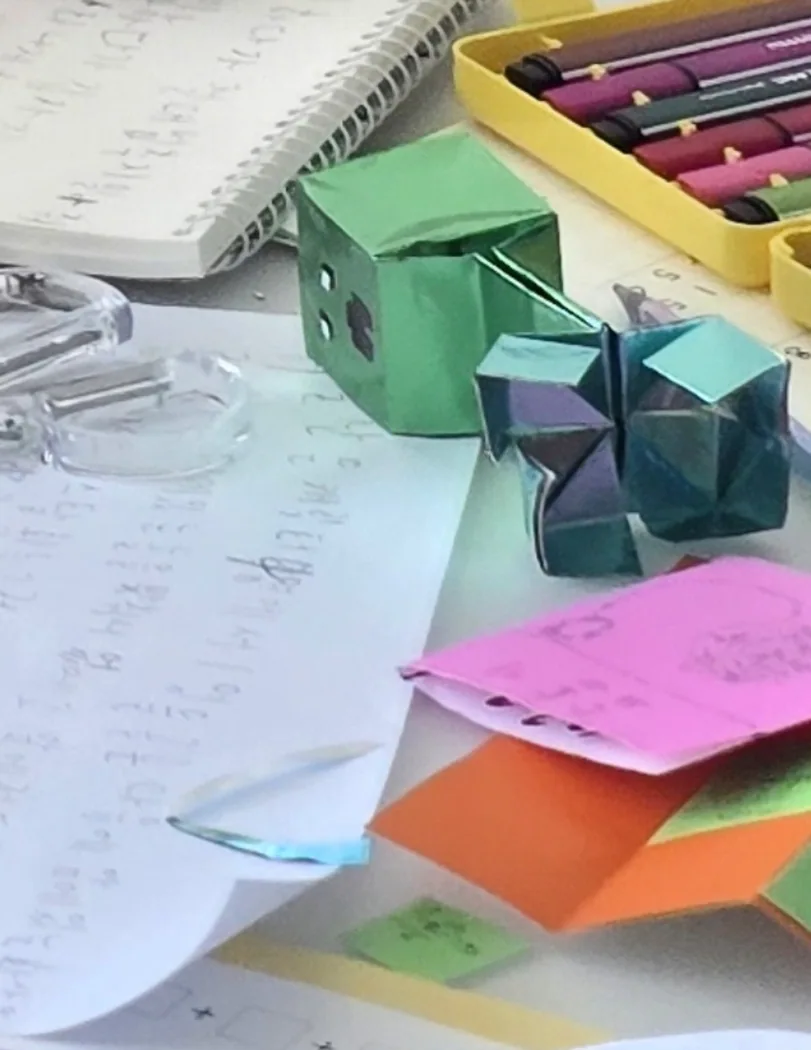
Colored paper, pencils, and the hand-folded characters sat on the desk. Next to them, the story on the page kept growing: caves, rocks, crystals, fish, and the sky.
Before long, the scenario my child had written by hand had gone well beyond a single A4 sheet. As I read it, I began to picture each part as a game screen.
Every rock had a reason to exist
The adventure begins in a green field. What looks like an ordinary rock is not something to simply walk past: breaking it might reveal fire, a sword, a hammer, wings, meat, or a crystal.
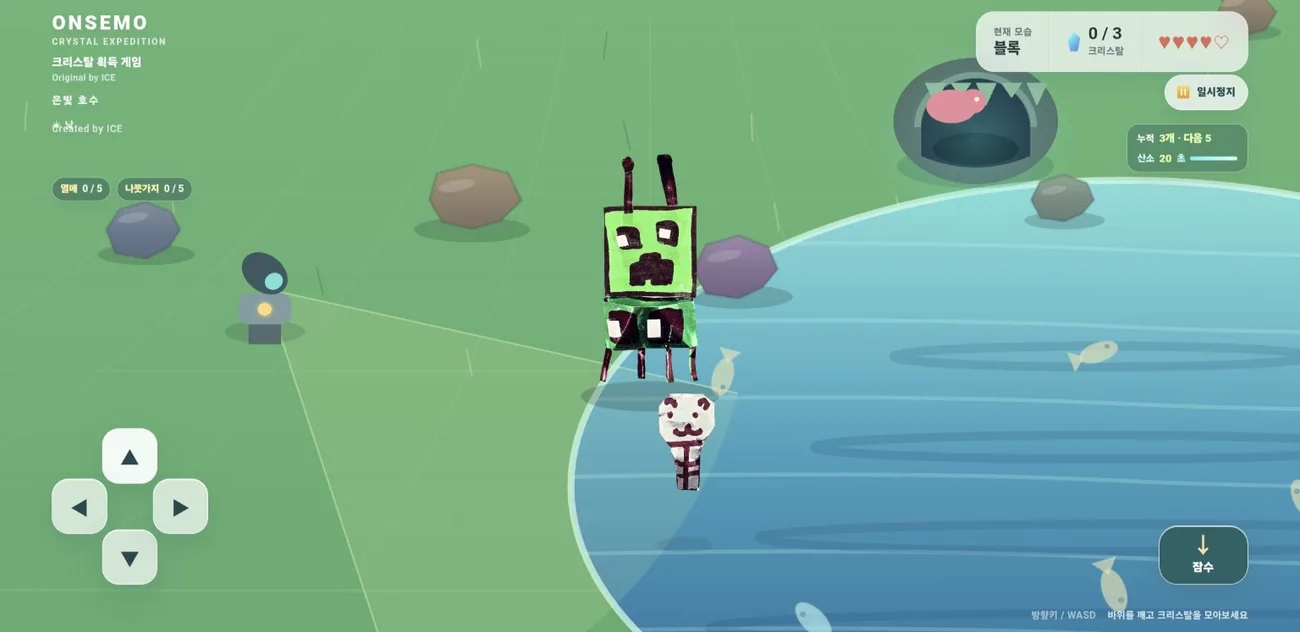
Crystals are especially important. Collect three and Galsaengi can transform into Block; collect more and the hero can become Good Zombie.
A rock was therefore more than an object in the background. It became something worth breaking to reach the next part of the adventure.
Of course, breaking rocks was not entirely safe. A robot with a CCTV camera for a head watched from the sky, while a Bad Zombie waited inside the cave. Hunting for crystals would require caution.
My child explained these rules as naturally as if the game had already been played.
Guardian Fairy needed to be near the cave
A Bad Zombie inside a cave would already be enough to create tension. But my child had another important condition.
As the hero approached the cave, the Guardian Fairy flying beside them needed to warn of danger. Not with an ordinary on-screen alert, but by having that little friend speak directly to the hero.
At first, the distinction did not seem significant to me. Either approach would communicate the same information. But my child kept emphasizing that scene, and I gradually understood why.
Guardian Fairy was not a decoration hovering over the game. In my child's story, the fairy was a genuine companion protecting the hero.
Working out how to make that conversation appear on the screen became another enjoyable part of the process. There is more to say about that scene in the next installment.
Flying through the sky and swimming in the ocean
My child's world did not end at the field or the cave.
Finding wings should make it possible to fly. Reaching the water should mean being able to enter the ocean and swim. There should be fish underwater, and catching them should be part of the adventure.
But the idea did not end with catching fish.
Cooking a fish over a fire and eating it should restore health.
To my child, this was one continuous adventure: catch a fish, cook it, eat it, regain strength, and carry on exploring.
Thinking about how to build it, however, raised more questions. How would the hero enter the water? How would fish be caught? When could fire be used? How would the screen show that health had been restored?
One sentence from my child became several tasks for me. I found that gap surprisingly interesting. My child kept creating the next part of the story, while I had to break it into pieces we could actually implement.
The same grassy field feels different at night
Expanding the world was apparently not enough. Time needed to pass as well.
My child imagined a game with a repeating day-and-night cycle. During the day, you might roam around breaking rocks and looking for crystals. At night, the mood should change.
And at night, a frightening wolf had to appear: an extremely powerful wolf.
I particularly liked that idea. A familiar field where the hero had wandered freely during the day would become a place to approach carefully at night. The map itself would not have to change for time to give the same location a different story.
The wolf was part of the dangers my child imagined for nighttime. What struck me most was not how much of that feature we had implemented, but that my child was already imagining the atmosphere of both day and night.
I thought one A4 page would be the end of it
I assumed that once we had organized the scenario that filled the paper, we could simply build each part.
But as the actual game screens began to appear, something unexpected happened. Rather than running out, the ideas multiplied.
Sizes and movements that seemed obvious in our imagination looked different on the screen. Once the cave was there, Guardian Fairy absolutely needed the right words. After seeing a transformation, my child wanted to make it more impressive.
My child picked up another sheet of paper and started writing again.
This time it was not a scenario. It was a handwritten list of changes my child wanted after playing the game. One request after another brought the total to more than thirty.
That was when I realized that the pleasure of making a game is not confined to the first moment when an imagined world appears on the screen. There is also joy in making that world better together.